Diary of a Newb
I have a vivid memory of being frustrated at the boss fight in Final Fantasy VI that expects the player to input Sabin’s blitz command, without really explaining all that well how to do it. Perhaps it’s one of those things that the developers thought players would come to the game with some experience playing fighting games in arcades. FFVI was released in 1994, meaning that arcades were still experiencing their heyday. It’s not an unreasonable assumption to make that people at that time would’ve played a fighting game or two.
Fighting games have always felt a little esoteric. The timing required to input a character’s moves is tight, and playing with a gamepad can be hit or miss depending on one’s preferences. The PS4 Dual Sense Controller has a terrible D-pad on it; it’s squishy and seems to wear out quickly. The PS5 D-pad is a little better, but still not great. One of my favourites of modern controllers is the Nintendo Pro Controller for the Switch.
Enter leverless controllers, specifically the Haute42 S16 model. I didn’t grow up playing on arcade machines regularly and I’ve never owned a fight stick controller. This Haute42 device is a game-changer. I’m still learning how to position my hands correctly. The experience is more akin to learning how to type on a keyboard again rather than using a game controller. Something clicked when I tried using my friend’s controller and he demonstrated the speed at which the combo moves need to be entered.
I’ve dabbled in a few different fighting games, but usually found my ability to reliably enter moves was lacking. Occasionally playing Super Smash Bros. with friends was usually fun — except for the fact that none of them bothered to explain some of the basic mechanics of the game, such as the “smash attack”. Generally speaking, Smash players are exchanging blows trying to get their opponents’ damage percentage above 100%, at which point a well-timed smash attack will inflict a great deal of knockback, possibly off the edge of the arena and counting as a knockout. But enough about a game that many fighting game enthusiasts dismiss as being for casuals (kidding, don’t throw things). Let’s turn to niche fighting games with tiny audiences.
I picked up Melty Blood: Type Lumina on the recommendation of a friend. MB is a series of fighting games using characters from a visual novel series called Tsukihime. I’m still reading through the VN. MB is well-known for being a bit easier for newcomers. Players can always rely on their normal moves automatically turning into a combo. In other words, pressing and landing three punches in a row becomes a combo. Same goes for kicks and heavy attacks. It’s a nice feature to help newbs get into the game as they learn the intricacies of the mechanics.
Things I’ve Learned So Far
The following notes uses fighting game notation. In no particular order:
- Crouch blocking (holding 12 or 23 depending on which side of the screen the opponent is) is important. Apparently it’s even considered over-powered in MB. Normal blocking is achieved by simply holding the direction button away from the opponent.
- Melty Blood: Type Lumina has extensive tutorials and training modes that let you learn the game at your own pace. While the tutorials are exhaustive, they may still be a little lacking for someone with little knowledge of the deeper mechanics of fighters. Total newbs, like myself, are best served by finding other players to teach them. Plus there are many online resources that break down the mechanics and define the lingo.
- If a longer combo seems impossible at first, the game speed can be slowed down in the training menu. Players are highly recommended to slow the game down to practice the move until the finger movements become a bit more familiar. Slowly increasing the speed as one practices makes a difficult combo much more attainable.
- Jump canceling — at least in Melty Blood — is accomplished with 89/78, and seems to be most important for achieving some of the longest and most complicated of combos.
- The game can save replays of matches, allowing players to learn from their opponents.
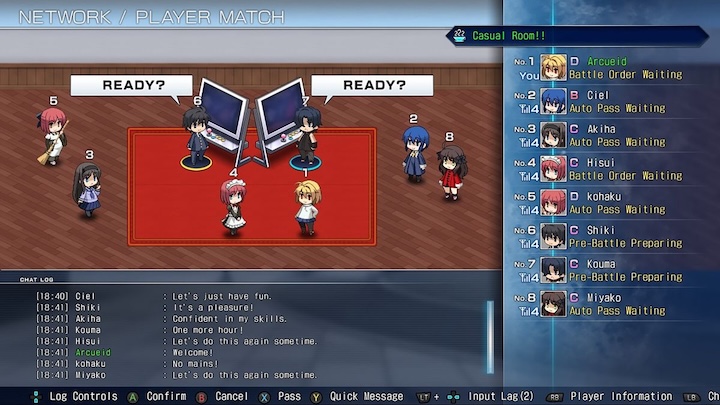
- The online lobby is cute.
My timing for getting into MB couldn’t have been better: a revision of Type Lumina is coming in early 2027. The subtitle “Twi-Lumina” looks a little clunky in English. The Japanese is トワイルミナ (towairumina; emphasis added), and I assume it’s trying to make a connection to the word “twilight”, which is written in katakana as トワイライト and pronounced towairaito. But that’s just a guess. Maybe it’s a specific reference to something from Tsukihime?
I’m happy to say that the things I’ve learned have applied to other fighting games as well. I had trouble pulling off the moves in the freeware Idol Showdown back when it released in 2023. Now with my leverless controller and MB knowledge, I made it through the tutorial and all the way to the final fight on normal mode. Alas, the final boss still kicked my butt. Oh well, at least I’m learning. It was also satisfying being able to make my chosen character, Korone, perform all of her moveset. Yubi yubi!
I’m eager to try other fighting games, old and new, to see whether my knowledge applies there as well.